
Unveiling the History of Abstract Expressionism
history of abstract expressionism

Unveiling the History of Abstract Expressionism

Dive deep into the revolutionary art movement that reshaped the American art scene after World War II.

Begin Your Journey

Key Takeaways

  • ✓ Emerged in New York City in the 1940s, becoming the first major American art movement.
  • ✓ Rooted in European Surrealism and the trauma of World War II.
  • ✓ Characterized by large-scale, non-representational works emphasizing emotional expression.
  • ✓ Divided broadly into 'Action Painting' (e.g., Pollock) and 'Color Field' (e.g., Rothko) styles.

How It Works

1
Understand the Precursors

Explore the European influences like Surrealism and Cubism, and the socio-political climate that set the stage for Abstract Expressionism. Recognize the shift from European to American artistic dominance.

2
Identify Key Figures

Learn about the pioneering artists such as Jackson Pollock, Willem de Kooning, Mark Rothko, and Clyfford Still. Understand their individual contributions and stylistic innovations that defined the movement.

3
Grasp Core Philosophies

Delve into the underlying ideas of existentialism, individualism, and the subconscious mind that fueled the artists' creative processes. Appreciate the emphasis on raw emotion and the act of creation itself.

4
Recognize Stylistic Traits

Distinguish between 'Action Painting' and 'Color Field' variations, noting their unique techniques, scale, and emotional impact. Understand how these elements contributed to the movement's revolutionary aesthetic.

The Genesis of a Movement: Pre-War Influences and Post-War Anxieties

Artistic arrangement of vintage TVs displaying static and blue screens in a minimalist setting. Photo: Miguel Rivera / Pexels
The birth of Abstract Expressionism, often referred to as the New York School, was not an instantaneous phenomenon but rather the culmination of complex socio-political forces and artistic developments that converged in the United States, particularly in New York City, during the mid-20th century. To truly grasp the history of abstract expressionism, one must first look at the turbulent decades preceding its emergence. Europe, the traditional heartland of Western art, was in upheaval. The rise of totalitarian regimes, the Spanish Civil War, and the looming threat of World War II led to a significant exodus of European intellectuals and artists to America. Figures like Piet Mondrian, Max Ernst, Marcel Duchamp, and André Breton brought with them the avant-garde ideas of Cubism, Dada, and Surrealism, exposing a new generation of American artists to radical artistic philosophies previously less accessible across the Atlantic. These European émigrés acted as catalysts, introducing concepts of automatism, the subconscious, and non-representational art that would profoundly influence the burgeoning American scene. Simultaneously, the American context itself was ripe for a revolutionary art movement. The Great Depression had fostered a period of social realism and regionalism in American art, often supported by government initiatives like the Works Progress Administration (WPA). While these programs provided vital support for artists, many felt a growing dissatisfaction with art that served a purely didactic or narrative function. They sought a more profound, universal language capable of expressing the anxieties and hopes of a world grappling with unprecedented conflict and technological change. The trauma of World War II, the Holocaust, and the dawn of the nuclear age left an indelible mark on the collective psyche. Artists felt a desperate need to create art that reflected this existential crisis, art that was raw, honest, and deeply personal, yet universally resonant. The pre-war experimentation with abstraction by American artists like Arshile Gorky and Hans Hofmann, who taught many of the future Abstract Expressionists, provided crucial technical and theoretical foundations. Gorky, in particular, served as a bridge between European Surrealism and American abstract painting, his biomorphic forms and expressive brushwork foreshadowing the gestural intensity of the movement to come. His untimely death in 1948 left a void, but his influence was undeniable, pushing artists towards a more organic, emotionally charged abstraction. The stage was set for a radical departure from traditional artistic conventions, paving the way for America to claim its place at the forefront of the global art world.

Defining Characteristics and Key Figures of the New York School
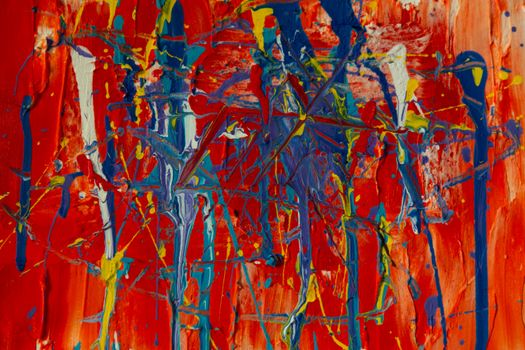
Dynamic abstract painting with bold acrylic colors on canvas. Photo: Steve A Johnson / Pexels
Abstract Expressionism, while diverse in its manifestations, shared several core characteristics that distinguished it from previous art movements and solidified its identity as the 'New York School.' Central to the movement was the emphasis on spontaneity, improvisation, and the direct expression of the artist's inner state. This was not art about external reality, but about internal experience, often deeply rooted in existentialist thought and Jungian psychology. The sheer scale of the canvases was also a defining feature, often monumental, intended to envelop the viewer and create an immersive, almost spiritual experience. The act of painting itself became paramount, a performative ritual where the artist's physical engagement with the canvas was evident in every brushstroke, drip, or splash. This led to the categorization of the movement into two main stylistic tendencies: Action Painting and Color Field Painting. Action Painting, exemplified by artists like Jackson Pollock and Willem de Kooning, prioritized the gestural application of paint. Pollock, famously known for his 'drip paintings,' would lay his canvas on the floor and pour, drip, and fling paint onto it, creating intricate webs of line and color. This method, often described as 'all-over' painting, eliminated traditional composition and perspective, focusing instead on the energy and rhythm of the creative process. De Kooning, while still gestural, maintained a more aggressive, often figurative, approach, particularly in his series of 'Woman' paintings, which blurred the lines between abstraction and representation with their ferocious brushwork. Franz Kline's large, bold black and white canvases, reminiscent of calligraphic strokes, also fall under the Action Painting umbrella, conveying immense power and immediacy. These artists used their bodies as much as their brushes, making the act of creation a visceral, almost violent, expression of emotion. Color Field Painting, on the other hand, moved away from the aggressive gesture towards expansive fields of color, emphasizing the meditative and contemplative qualities of paint. Mark Rothko's iconic 'multiforms' consisted of soft-edged, luminous rectangles of color that seemed to float on the canvas, designed to evoke profound emotional and spiritual responses. His work sought to transcend mere aesthetics, aiming for a sublime experience that could move viewers to tears. Barnett Newman's 'zips' – thin vertical lines dividing vast fields of color – were equally ambitious in their spiritual aspirations, intended to represent the sublime and the infinite. Clyfford Still's jagged, heavily impastoed forms, often recalling torn geological formations, presented an intense, almost primeval engagement with color and texture. These artists believed that color itself, when applied in large, undifferentiated areas, could convey universal truths and deep human emotion, creating an immersive, almost religious, experience for the viewer. While their methods differed, both Action Painters and Color Field artists shared a common goal: to create art that was profoundly personal yet universally resonant, pushing the boundaries of what art could be.

The Legacy and Enduring Impact of Abstract Expressionism

Bold and colorful abstract expressionist painting with textured brushstrokes and vibrant shapes. Photo: Steve A Johnson / Pexels
The impact of Abstract Expressionism reverberated far beyond the studios of the New York School, fundamentally altering the trajectory of modern art and cementing America's status as a global cultural powerhouse. Its revolutionary spirit challenged established norms of art criticism, patronage, and exhibition, paving the way for subsequent movements and influencing generations of artists worldwide. One of its most significant legacies was the elevation of the artist as a heroic, individualistic figure, whose personal struggles and triumphs were central to the creative act. This emphasis on the artist's psyche and process became a powerful narrative, shaping public perception of what it meant to be a modern artist. The large scale and emotional intensity of Abstract Expressionist works also demanded new ways of viewing and experiencing art, shifting focus from narrative content to the direct, immersive engagement with form, color, and texture. However, the movement was not without its critics. Some dismissed it as chaotic, meaningless, or self-indulgent, struggling to reconcile its non-representational nature with traditional aesthetic values. Clement Greenberg, a prominent art critic, became a staunch advocate, championing the movement for its purity and its move towards a purely optical, self-referential art. He argued that Abstract Expressionism represented the logical progression of modernism, purging art of all extraneous elements to arrive at its essential form. Despite the debates, the movement's influence was undeniable. It opened doors for new forms of expression, inspiring Pop Art's embrace of everyday imagery, Minimalism's reduction to essential forms, and Conceptual Art's focus on ideas over aesthetics. Artists like Jasper Johns and Robert Rauschenberg, while reacting against some aspects of Abstract Expressionism, directly built upon its foundations, particularly its scale and emphasis on the artist's presence. Beyond the art world, Abstract Expressionism played a crucial role in the cultural diplomacy of the Cold War era. The U.S. government, through various agencies, subtly promoted Abstract Expressionism internationally as a symbol of American freedom, individualism, and intellectual prowess, contrasting it with the perceived artistic repression of the Soviet Union. This strategic use of art helped solidify America's image as a beacon of artistic innovation and liberal values. Today, the works of Abstract Expressionists command astronomical prices at auction and are cornerstones of major museum collections globally. Their enduring power lies in their ability to communicate universal human experiences – joy, despair, anxiety, transcendence – through the raw, unfiltered language of paint. The history of abstract expressionism is not just a tale of artistic innovation; it's a profound narrative about human emotion, the struggle for self-expression, and the transformative power of art in a changing world. It continues to inspire and challenge, proving that its radical spirit remains as relevant today as it was in the mid-20th century.

Avoiding Misconceptions: Understanding Abstract Expressionist Nuances

Dynamic abstract painting featuring bold colors and rich textures, showcasing artistic brushstrokes. Photo: Steve A Johnson / Pexels
Despite its prominence, Abstract Expressionism is often subject to several common misconceptions that can hinder a full appreciation of its depth and complexity. One prevalent error is to view all Abstract Expressionist art as purely chaotic or random. While spontaneity and improvisation were key, the artists were highly skilled, often classically trained, and their 'random' gestures were typically the result of intense deliberation, practice, and a deep understanding of composition and color theory. Pollock's drips, for instance, were not haphazard; he controlled the flow, speed, and direction of the paint with remarkable precision. Another misconception is that the art is solely about anger or angst. While the post-war anxieties certainly fueled much of the work, many artists, particularly the Color Field painters, aimed for states of sublime beauty, spiritual transcendence, and profound contemplation. Rothko's work, for example, is often described as meditative and deeply moving, evoking a sense of the sacred. Furthermore, it's a mistake to conflate all non-representational art with Abstract Expressionism. The movement has specific historical and philosophical roots, distinct from earlier forms of abstraction like Cubism or Constructivism, or later movements like Minimalism. Abstract Expressionism is uniquely characterized by its emphasis on the individual artist's psychological state, the raw emotional content, and the gestural or color-field approach. It is also often misunderstood that the movement was a monolithic entity. As discussed, there were significant stylistic differences between Action Painting and Color Field, and even within these categories, artists like Arshile Gorky, Philip Guston, and Lee Krasner each brought their unique voices and approaches. Krasner, often overshadowed by her husband Jackson Pollock, developed a powerful, organic abstraction that deserves independent recognition. Finally, the idea that Abstract Expressionism is 'easy' or that 'anyone can do it' fundamentally misunderstands the intellectual and emotional rigor involved. The artists poured their entire being into their work, grappling with profound philosophical questions and pushing the boundaries of artistic expression. Their art was an intense, often painful, search for meaning in a fractured world. To appreciate Abstract Expressionism, it's crucial to move beyond superficial judgments and engage with the artists' intentions, the historical context, and the sheer expressive power of their creations. Recognizing these nuances allows for a richer, more informed understanding of this pivotal moment in art history. Key Takeaways: * **Not Random:** Spontaneity was controlled and deliberate. * **More Than Anger:** Explored a wide range of emotions, including the sublime. * **Distinct Style:** Unique historical and philosophical context. * **Diverse Voices:** Many individual styles within the broader movement. * **Intellectual Depth:** Demanded profound engagement from artists and viewers.

Comparison

FeatureAction PaintingColor Field PaintingPre-Abstract Expressionism
EmphasisGestural mark-making, raw emotion, processExpansive fields of color, spiritual contemplationNarrative, representation, traditional composition
Key ArtistsPollock, de Kooning, KlineRothko, Newman, StillGrant Wood, Thomas Hart Benton
TechniqueDripping, pouring, aggressive brushworkStaining, thin layers, soft edgesBrushwork, impasto, detailed rendering
ScaleOften monumental, immersiveOften monumental, immersiveVaried, often smaller or conventional
Emotional ImpactDynamic, visceral, explosiveMeditative, sublime, introspectiveIllustrative, didactic, sentimental

What Readers Say

"This article on the history of abstract expressionism is incredibly thorough. I've always been fascinated by Pollock, but now I understand the broader context and the genius of artists like Rothko too."

Sarah J. · Brooklyn, NY

"As an art student, I found the breakdown of Action Painting vs. Color Field incredibly helpful. It clarified so many concepts I'd only vaguely understood before."

Mark P. · Chicago, IL

"I used to think Abstract Expressionism was just random splashes of paint, but this article truly opened my eyes to the philosophical depth and emotional intent behind the movement. My next museum visit will be completely different."

Elena R. · Los Angeles, CA

"A very well-written overview. I appreciated the detailed historical context and the nuanced discussion of the artists' motivations. Would have loved a bit more on Lee Krasner's specific contributions."

David L. · Boston, MA

"From the pre-war influences to the Cold War legacy, this piece covered every angle of the history of abstract expressionism. It's a fantastic resource for anyone wanting to truly understand this pivotal art movement."

Jessica T. · Seattle, WA

Frequently Asked Questions

What is the most defining characteristic of Abstract Expressionism?

The most defining characteristic is its emphasis on spontaneous, emotional expression, often on large canvases, reflecting the artist's inner psychological state rather than external reality. It prioritized the act of painting and the raw energy of creation.

Why is Abstract Expressionism considered so important in art history?

It is important because it marked the first time an American art movement achieved international dominance, shifting the center of the art world from Paris to New York. It also fundamentally challenged traditional notions of art, pushing boundaries of form, content, and the artist's role.

How did Abstract Expressionism get its name?

The term 'Abstract Expressionism' was first used in 1946 by art critic Robert Coates in The New Yorker, combining the 'abstract' nature of the work with the 'expressionist' emphasis on emotional content, drawing parallels to earlier German Expressionism.

What was the average cost of an Abstract Expressionist painting when it first emerged?

Initially, many Abstract Expressionist works sold for relatively modest prices, often under a few hundred dollars in the 1940s and 50s. However, as the movement gained recognition, prices rapidly escalated, with major works now commanding millions, even hundreds of millions, of dollars.

How does Abstract Expressionism differ from Surrealism?

While Abstract Expressionism was heavily influenced by Surrealism's interest in the subconscious and automatism, it differed by largely abandoning recognizable imagery. Surrealism often used dreamlike, figurative elements to explore the subconscious, whereas Abstract Expressionism sought direct, non-representational emotional expression.

Who should learn about the history of Abstract Expressionism?

Anyone interested in modern art, American cultural history, the psychology of creation, or simply the power of emotional expression through art should delve into the history of Abstract Expressionism. It offers profound insights into the human condition and artistic innovation.

Were there any risks associated with the techniques of Abstract Expressionism?

From a practical standpoint, the scale and physical intensity of 'Action Painting' could be physically demanding and messy. From an artistic perspective, the risk was creating work that was perceived as chaotic or meaningless by audiences accustomed to more traditional, representational art.

What is the future trend for appreciating Abstract Expressionism?

Future trends suggest a continued deep appreciation for its historical significance and artistic merit. There's a growing interest in re-evaluating the contributions of overlooked artists within the movement, particularly women and artists of color, ensuring a more inclusive understanding of its rich history.

Embark on a deeper exploration of Abstract Expressionism. Visit local museums, read more scholarly articles, and allow yourself to be moved by the raw emotion and groundbreaking vision that defined this pivotal era in art history. The journey into the history of abstract expressionism is a journey into the very soul of modern art.

Topics: history of abstract expressionismabstract expressionist artistsNew York Schoolpost-WWII artaction painting
Leo List
Brampton weed
Adultwork EstrelaBet Vai de Bet R7 Bet Betão Galera Bet Rainbet Bet9ja Shop SportyBet BetKing Sisal Loto Foot Hollywoodbets YesPlay Odibets RushBet Jugabet BetWarrior BetCity MSport betPawa Fortebet